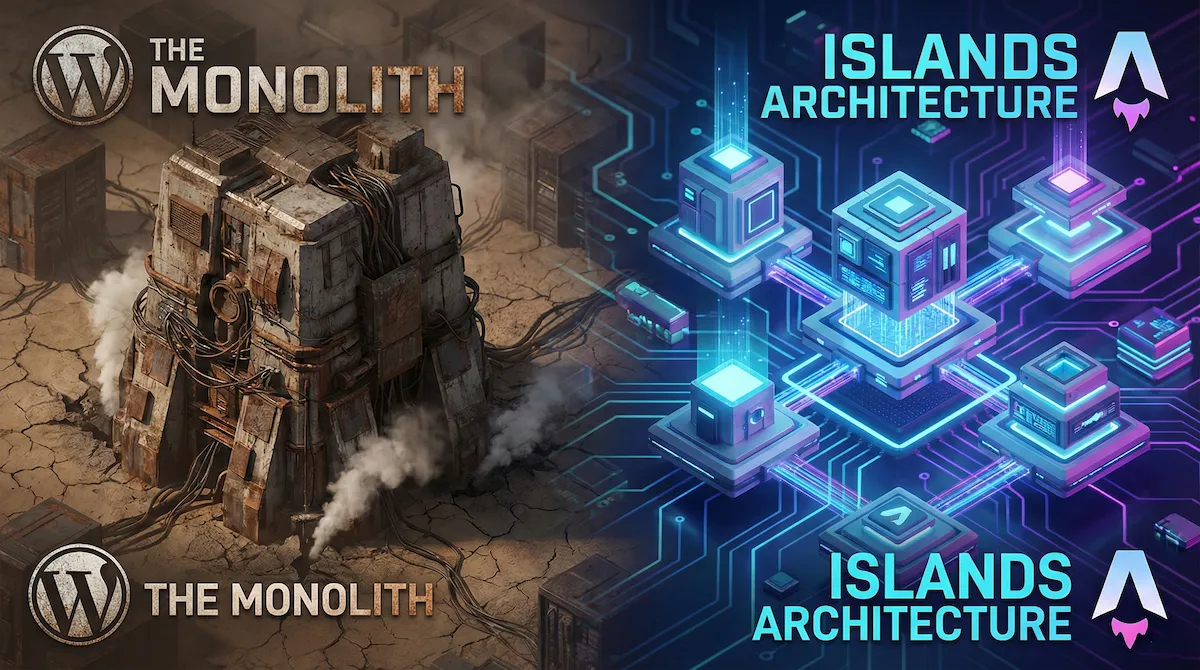
WordPress has democratized the web. There is no doubt about that. It powers a giant percentage of the internet and has its place. But if your business depends on speed, scalability, and flawless user experience, in 2026, using a monolithic CMS is like running a marathon wearing lead boots.
Many clients come to me frustrated. They have a visually acceptable website, but it takes 4 seconds to load on mobile 4G. The usual reaction is to install more plugins: caching plugins, image optimization plugins, minification plugins.
It’s like trying to fix a seized engine by slapping “Turbo” stickers on the bodywork. The problem isn’t the decoration; it’s the architecture.
That is why, at Ionastec, my default standard has changed. I have left PHP monoliths behind to embrace Islands Architecture with Astro.
The Monolith Problem (and Hydration)
The original sin of traditional websites (and many poorly made SPAs in older React/Next.js) is that they send too much JavaScript to the user’s browser.
When you enter a modern WordPress site full of visual builders (Elementor, Divi), the browser has to:
- Download bloated HTML.
- Download megabytes of unnecessary JavaScript.
- Execute that JavaScript to make the page “interactive.”
We call this “hydration.” It consumes battery, data, and your user’s patience. If your Time to Interactive exceeds 3 seconds, you are losing clients before they even see your offer.
The Solution: Islands Architecture
This is where Astro changes the game. Its philosophy is Zero JS by default.
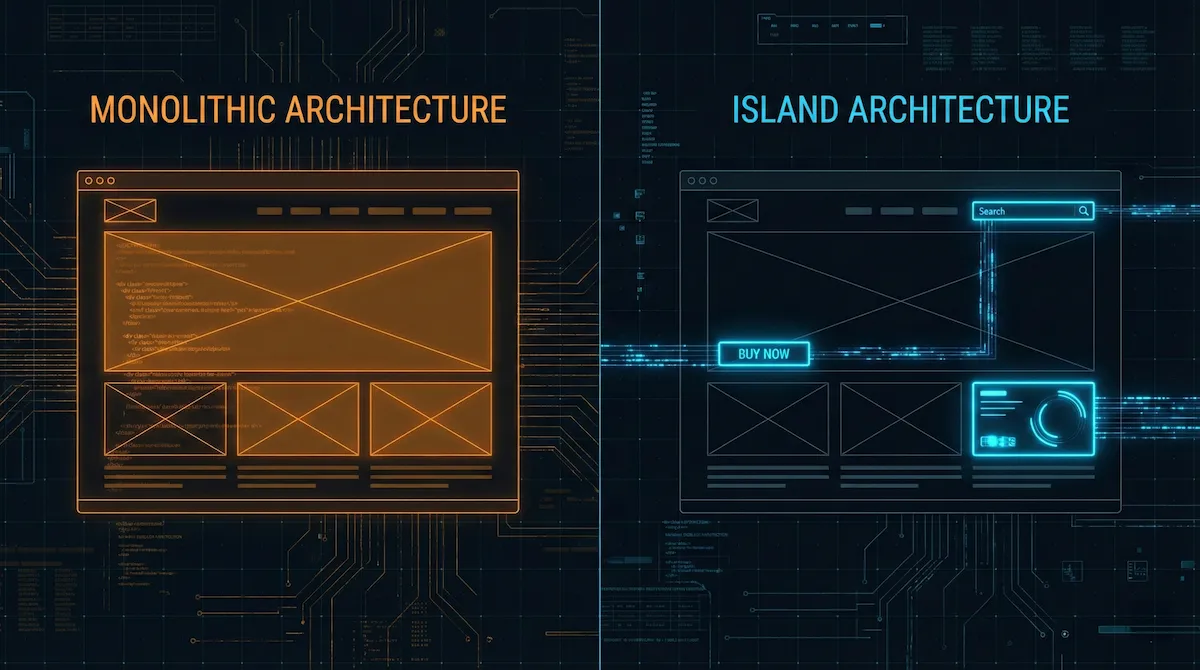
Imagine your website as a sea of static content (pure HTML, which loads instantly). Floating in that sea are small “islands” of interactivity.
- The text and images? Static HTML.
- The contact form? A small React island.
- The image carousel? An isolated Preact or Svelte island.
The browser only loads the JavaScript strictly necessary for that island, and only when it scrolls into view. The rest is pure, lightweight HTML served from the Edge.
The Strategic Nuance: Should I Kill WordPress? (Headless CMS)
Here is the secret many agencies won’t tell you: You don’t have to throw everything away.
I understand that your marketing team loves the WordPress editor. It’s comfortable, and they already know how to use it. The problem with WordPress isn’t its admin panel; it’s the part the user sees (the frontend).
My approach in these cases is to use Headless WordPress.
- Your team keeps writing in the WordPress they know.
- But we “cut off the head” (the slow frontend) and replace it with an ultra-fast interface built in Astro.
You get the speed of a Ferrari with the driving comfort of your daily car. It represents the best of both worlds.
Real Results: The Business Impact
I don’t migrate my clients to Astro for technological “hype.” I do it for profitability and pure metrics.
Moving from a heavy WordPress to a well-designed islands architecture, I have measured brutal improvements:
- Performance: Improvements of up to 400% in Core Web Vitals.
- SEO: Google prioritizes speed. A 100/100 score in Lighthouse is no longer a utopia; it is my standard.
- Costs: By serving static files, you don’t need expensive servers processing PHP 24/7. Hosting is cheaper, more secure, and harder to crash.
My Approach as an Engineer
I am not a fanatic who hates old tools for no reason. If you want a simple personal blog, a basic WordPress setup works.
But if you are building a digital asset for your company, continuing to use 2010 technology in 2026 is technical debt that you will pay with interest. I build websites that fly today and scale tomorrow.
If your current website feels heavy, slow, or you notice your Ad campaigns aren’t converting because the page takes too long to open, it’s time to stop patching the monolith and start building real architecture.