
Hosting is the only expense of a website that is decided by the price of the bill, and the one that conditions everything else the most. It is contracted in five minutes, paid a year in advance and then forgotten until something breaks. The problem is that the price of the bill is exactly the data that says the least about what you are buying.
What you pay when you pay three euros a month
Low-cost hosting is a product with very clear limits: a shared server where dozens of sites compete for the same CPU and memory, no backups you can verify and a support team that answers with templates. It is not a scam: it is a product designed for brochure websites that nobody is going to visit. The mistake starts when a business with real customers uses it for its main sales page.
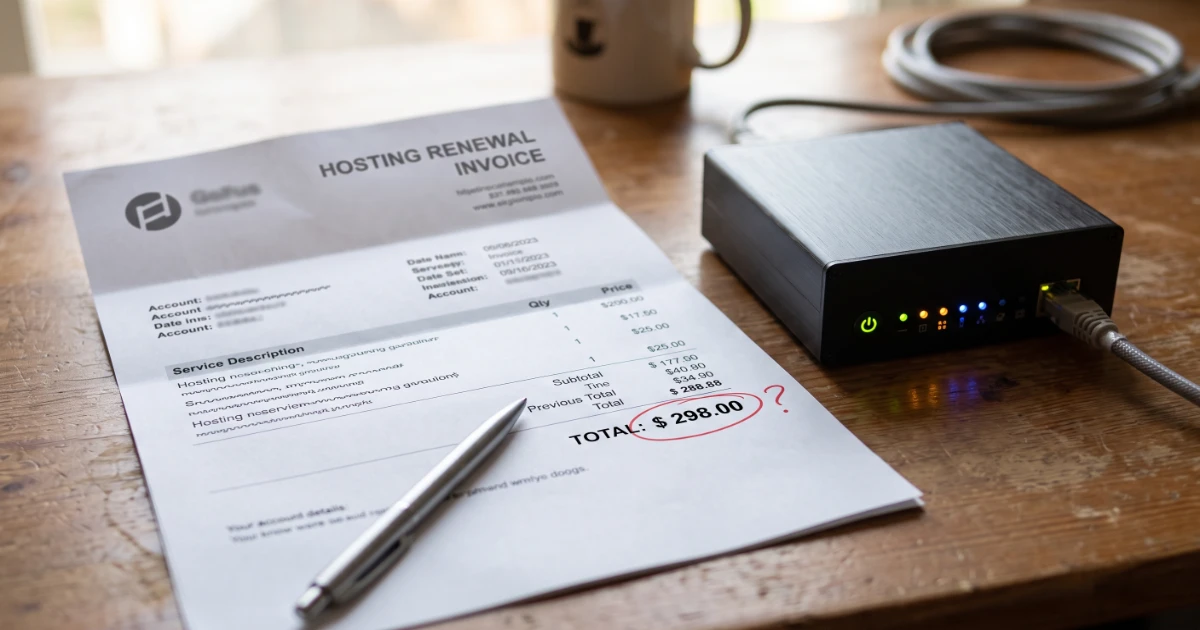
The renewal is another classic: the first year is sold at an acquisition price and the renewal goes up without warning, sometimes multiplying the initial cost. When the bill goes up, changing hosting with the domain and email already set up is a job nobody wants to do, so they pay and move on. Low-cost is not cheap: it is expensive in instalments.
Downtime has a billing price
A website that is down is not a technical problem; it is a cash-flow problem. Every hour without service means orders that are not placed, forms that never arrive, bookings that go to the competition and a customer support line filling up with people asking what is going on. The cost is not the price of the bill: it is what stops coming in while the website does not respond.
Cheap hosts do not offer SLAs (service level agreements) with real compensation, and when the server goes down, the usual response is to wait for the provider to restart it. A down website is not recovered with a reboot: it is recovered with discounts and apologies, and that has a cost that no control panel shows.
Speed is a conversion cost
Hosting determines the TTFB (time to first byte), which is the first data point Google measures when loading a page. A slow or saturated server makes the website slow to respond even when the design is impeccable, and that translates into worse Core Web Vitals, worse positions in search results and less conversion. It is the same logic that applies to the cost of a slow website: every extra second is paid for in results.
The difference is that performance is not fixed with more design or a plugin: it is fixed in the infrastructure. A saturated host turns any website optimisation into an effort the user never perceives.
Security also lives in the hosting
Backups, SSL certificates and server updates are part of hosting, not optional extras. On a poorly isolated shared server, a neighbour’s vulnerability can end up affecting your site, and a backup that has never been tested is not a backup: it is a promise. Your website is worth as much as its last backup, and that is discovered the day you have to restore it.
What it really costs to keep it alive
The real cost of a website is the total cost of keeping it operational: hosting, domain, email, verifiable backups, certificates and someone who responds when something fails. In that framework, options are better compared by what they include than by the number on the bill:
| Option | The real cost | Who it is for | Main risk |
|---|---|---|---|
| Low-cost shared hosting | The bill is the least of it: the cost appears in downtime, slow support and renewals that go up without warning | Personal websites, projects without critical dependency | Performance at the mercy of server neighbours |
| Managed VPS | A medium cost that already includes control and maintenance | Businesses with medium traffic and control needs | Requires technical judgement and dedication |
| Static site on a CDN | Minimal bill and, by the way, most downtime and security problems disappear | Content websites, catalogues, local business | No database or dynamic functionality |
| Premium managed hosting | The highest bill, in exchange for availability and support | Businesses with availability requirements | Paying more without performance justifying it |
The decision is not how much you pay per month; it is what kind of problem you buy. Hosting is not a bargain-store purchase: it is the electricity bill of your business, and it is decided the same way: by the reliability of the supply, not by the first-month offer.
Deciding hosting by the price of the bill is deciding by the least important data point. What you buy with that bill is uptime, speed and someone who responds when something breaks. The rest are savings that are paid later, with interest. If you want to measure the real impact of speed on your results, the starting point is the Core Web Vitals on web.dev.